
‘Prime time doesn't exist anymore’: Lauren Barnett, Samsung Ads on the rise of the Home Screen
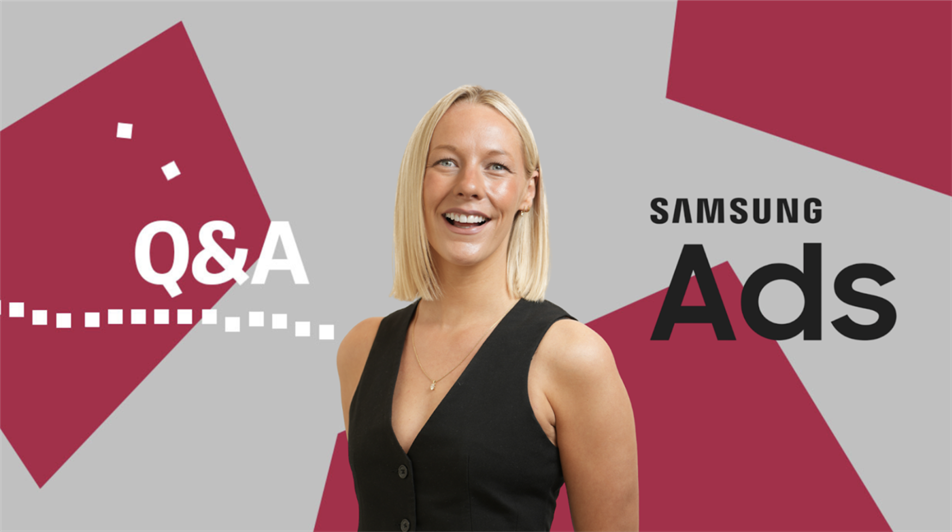
The Head of UK Sales at one of the biggest players in the TV industry explains how shifting focus to the point of discovery helps brands capture attention… before a single show even begins.
As streaming fragmentation makes traditional TV buys increasingly complex, the smart TV home screen has emerged as the most critical real estate in the home.
For Lauren Barnett, Head of UK Sales at Samsung Ads, this transition from traditional ad tech to the world of Connected TV (CTV) felt like a natural evolution rather than a pivot.
With a decade of experience across AI-driven mobile platforms and premium publishing at The Times, Barnett now leads a rapidly expanding team in a landscape where streaming has officially overtaken linear viewing.
PMW sat down with Barnett to discuss the evolution of the “lean-in” viewer, the power of Samsung’s proprietary data, and why the home screen is the ultimate antidote to audience fragmentation.
Q. Can you tell our readers about your career in digital ads so far, and the ambitions of Samsung Ads for the coming year?
I’ve been in the media world now for just over 10 years, which has gone by in an absolute flash. I started my career in adtech at a company called LoopMe, where I learned a lot of what I am today in terms of speaking to clients and negotiating. I then moved to News UK looking after the digital platform for
The Times newspaper, which was exciting and opened my eyes to what luxury and premium advertisers are doing. I had a short stint at Seedtag before joining Samsung.
I’ve been at Samsung for coming up to five years, and have absolutely loved it. I still feel like I’m in a new role all the time because of how quickly the industry is moving and how we’re pivoting as a company. What’s great about Samsung is that when I joined, it had that startup mentality, but you’re under the umbrella of a huge global household name.
The first few years I was an agency lead, primarily looking after Publicis. Then last year I moved into the role of Head of UK Sales, and since then, the team has doubled in size.
Q. The home screen is often described as the new landing page for the TV world. It’s becoming much more attractive to advertisers. Can its effectiveness be proven now more than it was a few years ago?
The home screen has come a long way. When people traditionally thought about CTV, they didn't even think about the home screen; they just focused on how to translate linear TV ad formats. The home screen now is CTV in its own right.
Samsung has the world’s largest TV dataset, which provides undeniable proof of the effectiveness of these campaigns. When the business launched, our bedrock was “endemic” brands – content partners like ITV and Amazon Prime. It makes sense because they want to be on that home screen. Nine out of ten people don’t know what they want to watch. I bicker with my husband every evening about what we’re going to watch! There’s a stat that people spend so long deciding that they often end up watching nothing at all and just go to bed. For content partners, that prominent home screen is fantastic because they can directly to link to content to engage users in that “lean-in” discovery mode.
Q. The Home Screen is traditionally seen as a place to promote endemic brands such as TV channels and shows – is this starting to change?
More recently, we’ve opened the home screen to “non-endemic” brands such as automotive, and luxury. We prove effectiveness for them through brand lift studies, looking at shifts in real-world metrics like brand perception and purchase intent. Something else we’ve launched is mobile. Being the OEM of both TVs and mobile puts Samsung in a unique position. Historically, we understood what people were viewing on TV; now we have a clear understanding of what they are doing on their mobile and how they are engaging with brands throughout the day.
The example I like to give is a sports client. You might think someone loves sports because they watch football, but they could be sitting there eating a pizza in tracksuit bottoms. If someone has Strava on their phone and uses it daily, they are probably an active person.
We can see the impact CTV has on a brand’s entire ecosystem. For UKTV, we ran tests last year and saw that as a result of the CTV campaign, they saw an increase of 13% in mobile app downloads.
Q: Are there other examples of how non-endemic brands can get noticed on the home screen?
It has emerged as a pivotal platform because it's such an effective way to capture attention. Fragmentation across the landscape is vast; it’s difficult to know where a user is going to be watching content. However, the home screen provides that gateway. As soon as you turn the TV on, that unit is there, so it is unmissable.
The home screen is the most visited area of the TV. In any user session, they go back to the home screen five times – and industry research shows that active attention on the home screen achieves 60% more brand recall than mobile and
34% more than desktop.
I think the other thing which is so good for brands getting noticed is that people used to talk about Prime Time, which would be more like 7pm to 10pm. Prime Time doesn’t really exist anymore. It’s now ‘consumer prime time’ – that’s what’s really key. If you’re trying to reach every user in your target audience at the time they want to watch it becomes near enough impossible because you need to know where they’re going to watch, and when they’re going to watch it – the home screen ads can combat that straight away.
Q: What is currently stopping brands from moving into CTV, and how can those problems be solved?
When I started five years ago, we got a lot more pushback than we do today. Now, brands reach out directly because they know the industry is shifting. Streaming now makes up the largest percentage of viewing.
However, there’s still a misconception about the premium nature of advertising on CTV. Some think it’s intrusive, but it’s actually embedded into the UI. Statistics show 37% of people actually want to be served ads as long as they are in line with their interests.
There is also resistance to moving budgets out of the traditional landscape. A big one is creative restraint. I spoke to a client who was required to make 300 different versions of her creative due to different specifications for all the platforms and TV models. That is unmanageable. Samsung launched its own Creative Studio to offer support and ensure high-quality advertising that aligns with platform requirements.
Q. You mentioned misconceptions, what is the biggest mistake or wrong assumption brands make when approaching Home Screen ads?
Some people assume there is a “one size fits all” for targeting. When you’re working with a company like Samsung, brands should lean into the data to find out what their audience are leaning into. For instance, using ACR (Automatic Content Recognition) data from four billion linear ad impressions tracked monthly, we can understand exactly what content households are exposed to across linear and streaming, and map how that exposure translates into app usage, brand engagement, and real-world outcomes.
The other big issue is looking at campaigns in isolation. We’re not saying linear is dead; it’s about how the two formats come together to drive incremental reach. When you complement a CTV campaign on the home screen with Samsung TV Plus and linear, incremental reach increases by 54%.
Also, make sure your creatives aren't misaligned. Film isn't just a digital asset, it's going to be on a TV that is 50 inches plus. It needs to be high-quality and designed for the living room, not for mobile or desktop.
Q: Can you share a recent success story that exemplifies how Samsung Ads works for clients?
Automotive has really been leaning in. Almost two thirds (61%) of car shoppers report that CTV influences their purchasing decisions. Last year for the Six Nations rugby, we worked with a brand that was not a sponsor. We strategically timed placements and roadblocks so that brand was the first thing people saw before they watched the rugby. We saw a staggering 66% of respondents link that brand to the tournament. It’s a clever way to get the benefits of a sports sponsorship without being a direct sponsor.
Q. “Lean in without going all in” is a great soundbite! Are there any other new formats that have worked well for brands?
We’ve recently launched the Immersive Masthead Carousel. Rather than one unit, it sweeps through different images every five seconds. Volkswagen tested this; it looks beautiful because you can see the same car in different colors or different models. It captures attention and lets them show off creative assets. From a performance point, we’ve seen view-through and click-through rates exceed benchmarks by over 50%.
Also published in:
Performance Marketing World
More from our team & client partners