
Levelling the Playing Field and Driving Programmatic Efficiency at Scale with Larraine Criss
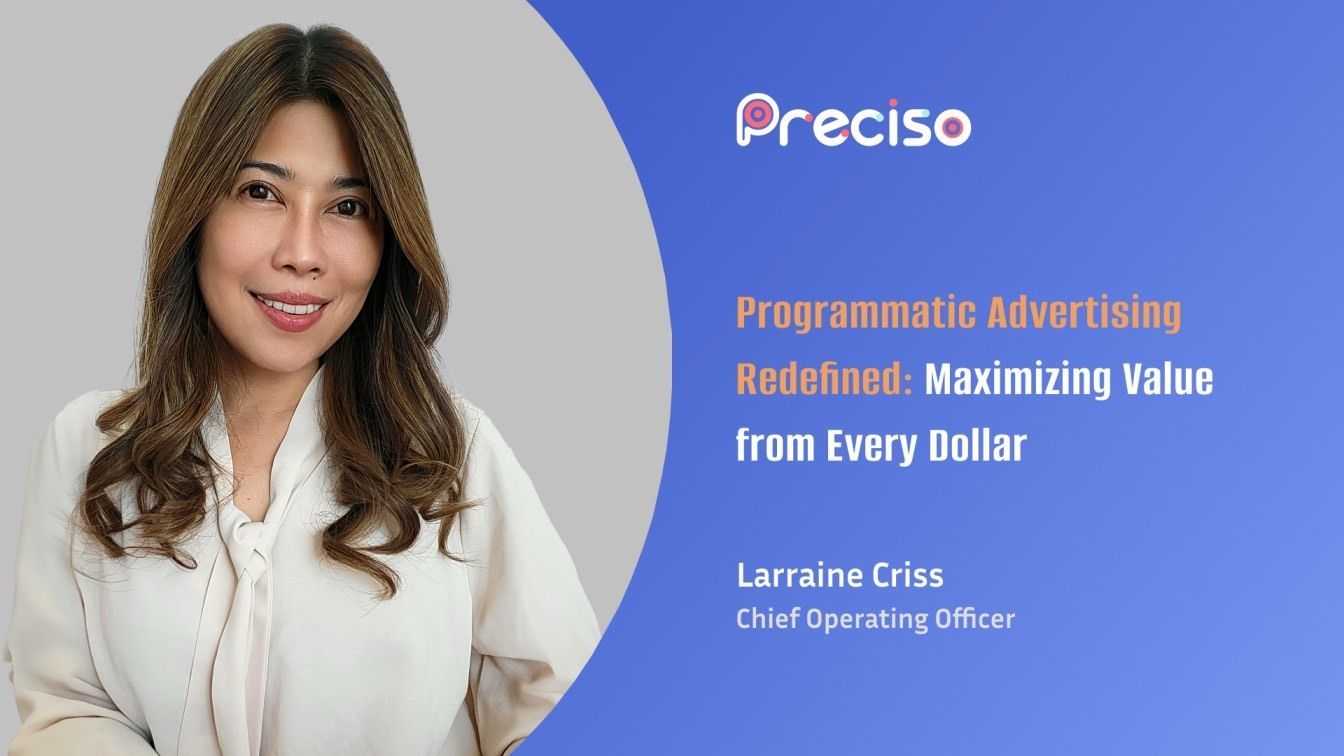
More spend doesn’t win in programmatic advertising. Better bidding does.
In this conversation, Larraine Criss, COO at Preciso, unpacks what it takes to level the playing field in programmatic advertising – from evidence-led operating decisions and bid-level precision to scaling performance without wasting spend. She shares candid perspectives on where adtech still breaks, how Preciso designs around those fault lines, and why disciplined bidding logic is the real engine of sustainable growth.
You’ve moved between founder, product leader, and now COO. Which operating bias do you consciously bring into decisions today, and which one do you actively guard against?
I bring a strong bias towards evidence-based decision-making because I have learned from experience that not all requests are inherently valid. In practice, it means that before committing budget or resources or making operational decisions, I focus on understanding the proof of concept to see if the request has any underlying business impact.
Conversely, I actively guard against my natural tendency to move quickly and decide independently. As a COO, I’m becoming more conscious of not defaulting to that, as I know collaboration adds so much value.
Whenever a decision involves execution, I always make an effort to involve department managers, so the decisions I’m approving on behalf of the company are grounded in operational reality and supported by the teams who will deliver them.
Take us through the Preciso Smart-Bid platform. What core advertising bottlenecks does it resolve, and how does it inject precision into today’s display advertising?
The Preciso platform was built to address one of the biggest bottlenecks in display advertising, which is programmatic redundancy. Our solution brings precision by controlling how often, when, and to whom ads are shown. It helps brands reach the right audience at the right time and reduce unnecessary impressions or overexposure. As a result, our partners get more value from every dollar spent.
Preciso gives smaller merchants access to the same traffic as large brands. From a technology and operations standpoint, where is that advantage truly created – at bidding logic, inventory selection, or spend orchestration?
The advantage is created across all three of those areas. Preciso Smart-Bid is budget-agnostic, meaning it doesn’t favour advertisers simply because they can spend more. And instead of trying to exhaust a daily budget, the system focuses on identifying and bidding on the opportunities that truly align with specific campaign goals. This allows smaller merchants to compete fairly for the same quality traffic as large brands.
Ultimately, we focus on bidding precision and the client’s objectives, rather than looking at the spending power of the advertiser.
What part of the adtech stack tends to break first when performance marketing scales? How has Preciso designed around that?
When performance marketing scales, what usually breaks first is not the adtech infrastructure but the bid decision or logic quality. As volume increases, many existing systems and DSPs struggle with pacing, frequency control, and bid efficiency, leading to wasted spend, inconsistent performance, or declining ROAS.
At Preciso, we focus on being able to scale bid decision quality alongside volume. While what we offer is highly scalable, in part because we have a cloud-based infrastructure for the server, our principal priority is maintaining real-time bidding logic and signal accuracy as a campaign grows. The platform is uniquely agile, and we can ensure performance, efficiency, and reliability alongside scalability.
With deep experience in real-time bidding and ad ops, which inefficiency in the programmatic value chain do you believe is still structurally underestimated?
For me, the most underestimated inefficiency in the value chain is still bidding logic structure. Even though programmatic is a mature industry, very few platforms truly prioritise bid decision quality, even though it is key to both the user experience and long-term marketing performance.
This is understandable from a business perspective, because quantity scales revenue more easily, so bidding logic with a focus on quality signals, rather than sheer volume, is still not the norm. It is, however, fundamental to our offering at Preciso.
Having led product before, where do you see the biggest friction between product ambition and operational reality? How do you resolve it without slowing execution?
The biggest friction happens when product ambition is driven purely by either commercial vision or operational comfort. When ambition is determined exclusively from a commercial perspective, it can be market-relevant but operationally complex. When it’s driven entirely from the operational side, it may be easier to deliver but lack market impact.
We resolve this by anchoring product ambition on proof of concept and measurable business output. These parameters allow us to validate relevance and, at the same time, quickly align teams to move forward without slowing execution or overbuilding in the wrong direction.
As customer volume and spend scale simultaneously, how does Preciso plan its next moves?
Being in a fast-paced industry, we plan our next moves by first analysing current market trends and then looking ahead to identify potential opportunities. Lastly, we align these collected insights with the performance and successes of our past implementations. This approach allows us to make informed decisions as customer volume and spend grow.
Also published in: Technitel Pro
More from our team & client partners