
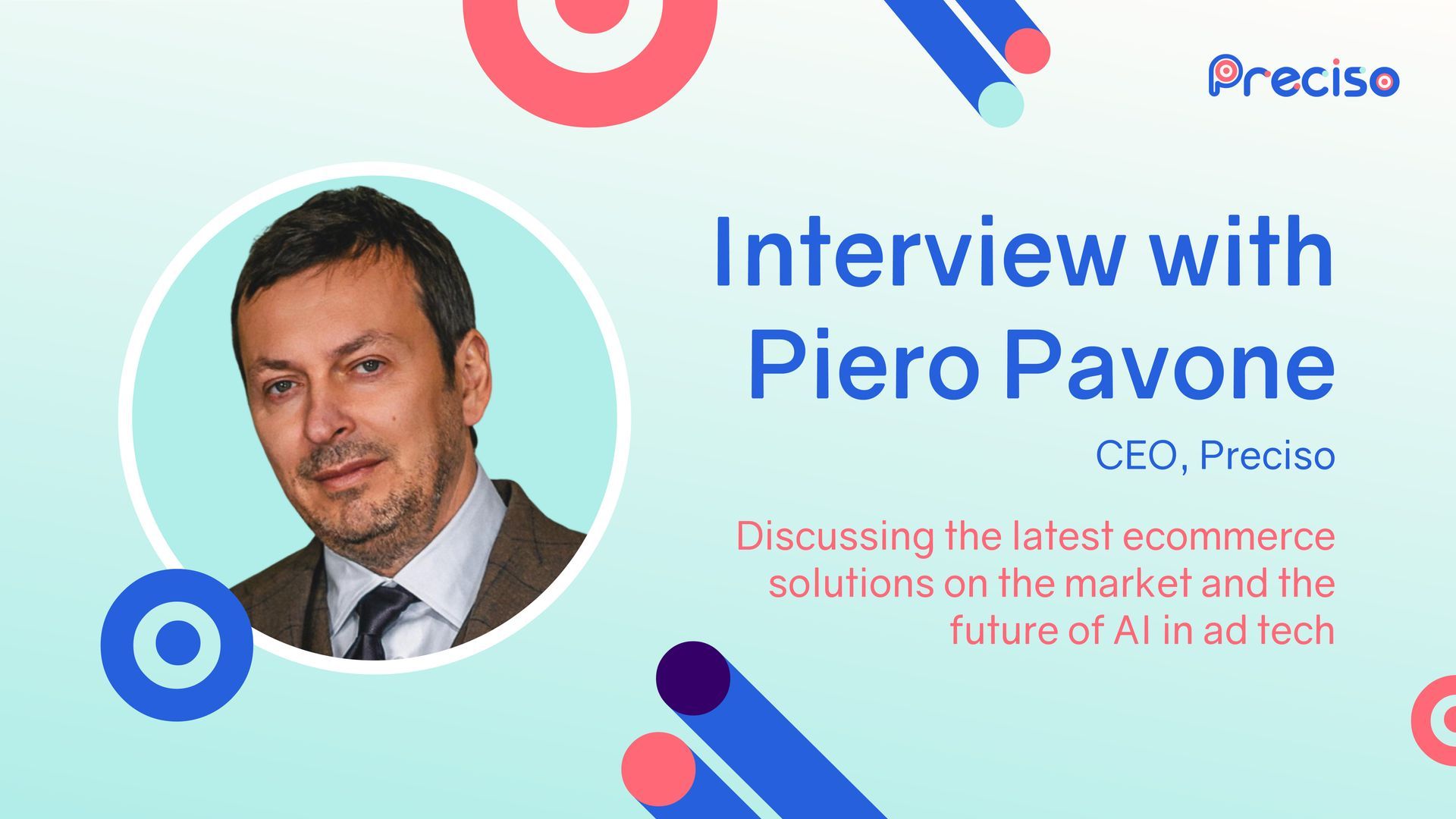
MarTech Interview with Piero Pavone, CEO at Preciso
Please tell us a little bit about your journey and what inspired you to start Preciso.
I have more or less 20 years of experience in the industry, from online marketing and email marketing to Google AdWords, and then display advertising. Preciso is the result of several years’ hard work testing the first DSPs in the market, such as AppNexus and other tools available in the industry.
Then, in 2016, we built our own smart bidding tool and over the years we focused on continually improving it, until we were ready to launch it in 2020, when Preciso was born.
Tell us about the current trends in the current European ad tech market. How did the pandemic change the landscape?
The pandemic has of course been a leading factor for change in the industry, with ecommerce growing exponentially. More consumers are buying online than ever before, especially in European countries where infrastructure for online shopping is second to none.
So the focus for us and the ad tech industry now is integration with big ecommerce platforms, such as Shopify, Magento, Bigcommerce and WooCommerce, to simplify the process of buying online advertising campaigns for smaller companies who are selling online.
What are your core offerings? How do you incorporate various advanced technologies to create ad tech solutions for large and mid-sized companies?
Our DSP is an easy-to-use, full-service platform for ecommerce businesses, enabling advertisers to launch and optimise their campaigns in just a few clicks. The platform manages the entire process of campaign optimisation and product recommendations automatically – which current DSPs simply don’t do. In our case, there’s no need for an internal team to manage it.
Preciso is also fully integrated with the major ecommerce platforms I mentioned above, plus a range of other integrations such as WordPress. What’s more, while the larger DSPs require a minimum budget, we don’t have a minimum ad spend requirement, making this type of smart bidding technology accessible to brands of all sizes.
What kind of support and services do you offer to enhance customer lifecycle value?
The core strategy of Preciso Smart Bid is to enhance the customer data life cycle and retain customer loyalty. Our platform is powered by machine learning, business logic and an intelligent ranking system – which ranks customer profiles on a scale of one to five (one being the highest priority) based on their online behaviour.
These features ensure the client is bidding effectively and reaching the best possible audience for their campaigns, which in turn means they are more likely to attract those who will become loyal customers, leading to better customer life cycle value.
Retail media is becoming an important revenue stream for brands today, but how easy is it to integrate into major ecommerce platforms such as Shopify? How does your tech help them do this?
Large enterprises often rely on programmatic advertising to improve click-through rates, impressions and overall campaign Return On Ad Spend (ROAS). But smaller businesses, many of which use Shopify to host their ecommerce stores, have fewer options available to them in programmatic advertising.
We bring the technology that big businesses are using and deliver it via an easy-to-use API integration with major ecommerce platforms. In a few clicks, an SME can integrate the smart bidding technology into their online store, ready for fully optimised campaigns.
What is a unique product marketing campaign that you led at Preciso – how did you measure the effectiveness of this campaign?
I’d name two long-term clients – Cleartrip, a travel business, and DHgate, a wholesale retailer – for whom we’ve managed many successful campaigns, both before and after forming Preciso as it is today. Of course, we measure the important metrics, such as conversion rates, impressions and click-through rates, but with Cleartrip and DHGate as examples, we’re also able to analyse long-term campaign performance data to find trends over time. This deeper level of understanding has enabled us to offer much better advice on the best metrics to use over time, and make the best optimisations.
ChatGPT and Google’s Bard have taken the tech industry by storm. How could generative AIs transform the way ad tech companies integrate high-tech products for next-gen brands?
Our platform has been using AI and machine learning for a long time now – approximately six years – using some of the fastest databases in the world. So we’re well placed to keep up with advertisers’ needs in such a rapidly-evolving world.
With ChatGPT and Google Bard, they’re bringing the AI and ML conversation to the forefront for sure, but the main thing generative AI is changing is the way users search for content online. That’s where the focus is right now – in search.
For the time being, I don’t see these changes directly impacting the ad tech industry, but technology moves quickly and the situation might change.
Also published in: MarTech Series
More from our team & client partners