
When AI meets creativity: the only limit is our imagination
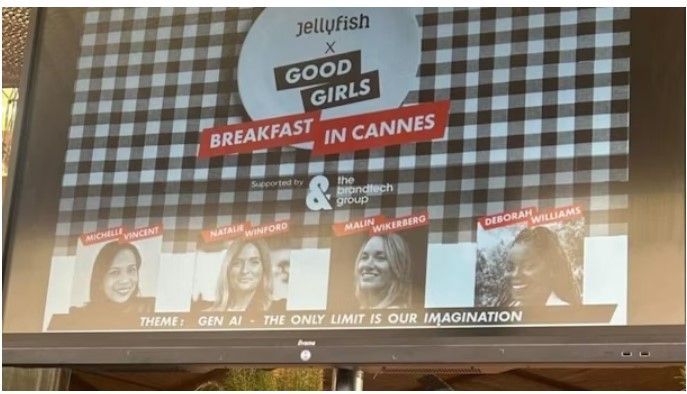
One of the recurring themes at Cannes this year was exploring the intersection between AI and creativity. Our Global ECD, Jo Wallace, hosted a Good Girls x Jellyfish breakfast session entitled Gen AI: the only limit is our imagination. Here’s a short run down of what was a varied and insightful conversation.
Kicking off, Jo Wallace observed that currently only a fifth of all of AI leadership is female (just 22%). Underlining the importance of hearing from female leaders across the creative field, who don’t necessarily claim to be AI experts but who, like most of us, are up-to-speed on developments and use some form of AI in their day-to-day roles.
Jo continued: “The exciting reality is that we are living through the greatest creative revolution in history. AI represents a step change in what we can achieve creatively. For example where we were previously restricted by physical or budgetary boundaries, AI can (in many cases) offer a solution. The only limit is our imagination.”
We panel dived into this topic, starting with:
How does AI affect our personal and work lives?
Speaking on the presence of AI in our daily lives, MoFilm’s CEO Michelle Vincent said, “When it comes to ChatGPT, she is my friend, she is my copywriter, and she helps me with events. I’m also mum to two teenage boys, and we use Discord group chat together as a family.”
Deborah Williams, Founder & CEO at The Women’s Association, agreed: “As a founder of my own business, I’m always too much in my head - so ChatGPT has become my friend. Also, I’ve never been good at Photoshop, so AI is helping me imagine creatives that don’t currently exist.”
The discussion moved on to how technology is playing an ever-increasing role in blurring the lines between our work and personal lives. For instance, it could be said that the mobile phone allowed anyone to become a creator. Fast-forward to 2024, and now we’re seeing the next evolution with the emergence of AI. As Jo mentioned, earlier this year OpenAI revealed their text-to-video model, Sora. The demo reel showcased some pretty remarkable AI videos created from written prompts, including a woman walking along a street and a litter of golden retriever puppies playing in the snow.
Our Global Chief Solutions Officer for Creative & Experience, Natalie Winford, said: “I’m excited about integrated tools such as Microsoft Copilot and Google Gemini, and our proprietary tool Pencil which lets you build custom templates rather than having to start from scratch. I’m not thinking robots will take over the world but I’m happy to embrace how AI can help us in our daily lives.”
In a world increasingly fuelled by AI, what will be the differentiator?
While AI is playing an increasingly important role in the creative process, it’s important not to underestimate the value of human input. The skillset and experience of a strong creative are vital when it comes to knowing how to best prompt AI tools to get the best from them - without this, everything could start to look the same. As Jo said “AI is too powerful a tool not to direct.”
Others made the point that, in future, we’ll likely need to opt out of custom GPTs (Generative Pre-Trained Transformers) feeding our data back into their AI models and helping our competitors.
The future of AI in creative industries
Malin Wikerberg, Executive Creative Director, BBDO Nordics, emphasised the importance of retaining a human element throughout the creative process.
“More ideas will create more good ideas - AI will certainly help speed up many aspects of the creative process. But let’s be mindful that with more possible routes of creativity, time will be required to explore them and ensure they are original and also well crafted.”
She continued: “There are exciting new possibilities, for example a small business could potentially feature a celebrity in their ad through the use of GenAI - without the usual high costs associated with celebrity endorsements.
But in summary, I would say the tech is how we do things, and people are the why.”
Picking up on this regarding human excellence meeting AI brilliance, Natalie made the point: “At Jellyfish we have two great offerings which intersect. AI Studios, which is all about content production and localisation at scale, across all different markets, and not only links to social but also optimises creatives in real-time. And then we have Creative Collective, which is where human creative ideation and excellence is supported by and very much aware of AI solutions - from providing start-points for creative insights or optimising production.”
The future of AI in creative industries
The future will clearly be very much AI-enhanced but, for now at least, it’s not all plain sailing when it comes to legal matters. For example, one panellist revealed that when she needed to create a sizzle reel for a recent session on the topic of GenAI, the legal team vetoed the use of GenAI to create the background imagery. So, instead she had to scrape the internet for original content using reverse image searching.
Deborah Williams, acknowledged a valid point that for all the brilliance AI brings us, we must continue to be mindful of the inherent bias and work to bring awareness - and rectify this - as we move forwards.
The Consensus
In short both the panel and the audience seem aligned that humans and AI will continue to collaborate more and more as we continue to set new benchmarks for what is possible when it comes to creativity. Michelle Vincent noted that “only 35% of Gen Z care so much about authenticity (versus half of millennials and boomers), meaning it looks likely that AI influencers will coexist with AI creators.”
“You will see a change in job roles,” says Natalie, “but it’s all about adapting to change”.
The main takeaway of the session? Don’t fear AI - embrace the possibilities.
Also published in: The Drum
More from our team & client partners