
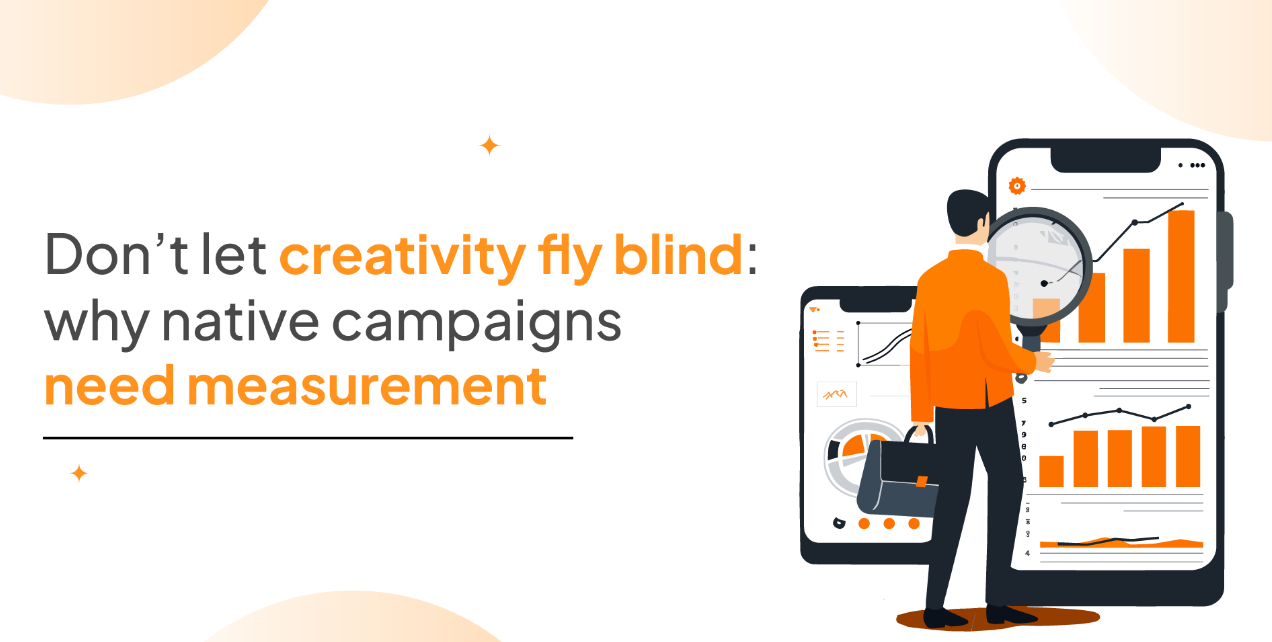
Don’t let creativity fly blind: why native campaigns need measurement
Native and sponsored content campaigns can provide an extremely powerful channel for advertisers to use to build positive perceptions towards their brand. They can integrate a brand’s message seamlessly into a publisher context in a creative way, taking advantage of the relevance of the environment and the trust of the audience.
Research bears this out: a survey of around 2,000 campaigns for our white paper “Did Your Last Campaign Work?”, published with the Native Advertising Institute, found that the average total brand lift delivered by native campaigns was +20.6%, compared to +10.0% for display campaigns.
So, native advertising clearly works, but it works in a different way to display advertising.
Display vs data: two different ways to make a connection
Display can be described as “push” advertising. It reaches large numbers of people on multiple occasions and seeks to push its message to a broad audience who are not necessarily looking to receive communications from the brand.
By contrast, native can be described as “pull” advertising. It reaches a smaller audience who are potentially more interested in the category, the advertised brand, and a greater depth of communication.
To use an analogy, if display is you working in a cafe, meeting lots of different people, and indeed the same person many times, across the counter, then native is you having dinner with one person for a long time, eye to eye, across a small table.
Working in the cafe might be an excellent way of acquainting yourself with lots of people who you could potentially ask out for dinner, but it’s not going to get you married. Having dinner might lead to this, but remember that acquaintances are much likelier than strangers to accept your dinner invite.
Comparing campaign start points of awareness, consideration, preference and action intent, we can see that those being exposed to native campaigns - like the dinner date example - are typically more familiar with the brand in the first place and are therefore potentially a more fertile audience for receiving an in-depth brand message.
All of this goes to show that native campaigns can play a different and potent part of an overall campaign mix, using creativity to cut through and engage the publisher’s audience in a way that standard display advertising is not normally capable of achieving.
Creativity still needs measurement
According to Twyla Tharp, a renowned American dancer and choreographer, “Creativity is messy, and it's unpredictable. You can't put a meter on it.” But, with respect to Twyla, we do need to find a way to put a meter on it, to prove its effect and to justify the advertiser dollars spent on it.
By gauging brand lift, we can add context to creativity, ensuring that every brushstroke, every word, every frame contributes meaningfully to the brand's story.
Beyond pure campaign effectiveness, there are other positive reasons to embrace native campaign measurement. In the age of digital storytelling, data isn't just for number crunchers; it's the fuel for creativity. By measuring brand lift, you're not stifling creativity; you're empowering it with insights that transform good ideas into great campaigns
Meanwhile, marketers often talk about ROI in terms of financial gains, but what about the return on the imagination invested in crafting a compelling narrative? Measurement lets us quantify the impact of creativity turning intangible concepts into tangible results. It also breaks the echo chamber of internal praise, providing objective feedback from real audiences and revealing blind spots that even the most creative minds might miss.
Things we have learned:
“Did Your Last Campaign Work?” contains just a sample of the data we hold, and continue to collect daily, on behalf of native advertisers around the world, and it all leads us to five broad learnings:
Native campaigns work differently to display campaigns
Whilst display campaigns reach a large audience and “push” their messages, native campaigns reach a smaller, more engaged audience who have been “pulled” towards the brand. The challenge to advertisers is in developing native campaigns that will build on the audience’s greater familiarity with the brand.
Native campaigns are consumed for longer periods of time
Native campaigns are typically consumed less frequently and for longer periods of time and it is this that leads to greater positive effect on the brand. The challenge to advertisers is in developing native campaigns that can engage an audience and encourage them to stay longer with the message.
Native campaigns work most strongly in the mid funnel
The data shows native campaigns have a greater relative effect on mid funnel metrics, especially consideration. The challenge for advertisers is in deciding on which metric they want to influence and then developing content to address that objective e.g. “Why would people want to consider our brand more often?”
Native campaigns work differently in different industry categories
We measure campaigns across 19 major categories and 122 subcategories with the data showing how native advertising performs differently in different categories. The challenge for advertisers is to understand how native advertising works in their category, which metrics are most typically impacted and what creative is best placed to have a positive impact.
Campaign planning benefits from consistent measurement data
To develop future campaigns based on insight from the past, it is necessary to measure as many native campaigns as possible. The more data you have, the more hypotheses you can explore and the more granular your analysis can become. The challenge to advertisers is to integrate a measurement element into their processes to capture brand lift metrics in a simple and scalable way.
Which brings us back to the headline. Don't let creativity fly blind. Imagine crafting a masterpiece without ever stepping back to see if it resonated with your audience. Native really works, but measurement is the lens that sharpens creative brilliance, ensuring it's not just visually stunning but also strategically effective.
Also published in: Martech Edge
More from our team & client partners