
Particular Audience introduces modular retail media solutions to cut costs and accelerate innovation for RMNs
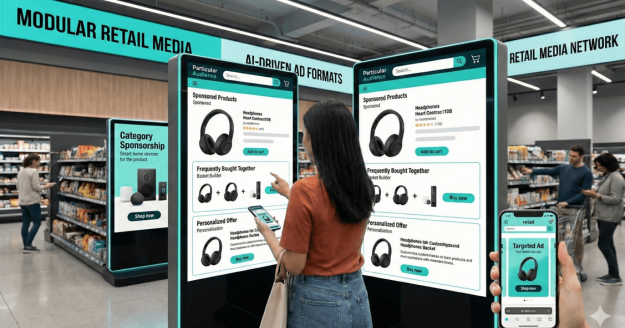
Particular Audience, the AI-powered platform transforming retail media and personalisation, has launched a suite of modular retail media tools designed for Retail Media Network (RMN) operators seeking to augment their incumbent adtech platforms with cutting-edge technology.
The components allow retailers to plug advanced ad formats and AI-driven personalisation into their current systems without the need to rip and replace. The result is expanded capabilities and higher-margin ad revenue – all while preserving a seamless customer experience.
“The era of monolithic retail media is ending,” said James Taylor, CEO of Particular Audience. “Modular retail media introduces a new way for retailers to build and scale commerce monetisation – feature by feature, rather than by adopting a single closed platform.”
The Modular Retail Media, or ‘MRM’, solution consists of 13 modules, all corresponding to clear objectives, from Personalisation to Reporting. Each module enables specific advertiser objectives such as Conquesting, Basket Building, Share of Voice, Re-activation, and Awareness – all within one modular framework. Each component is interoperable by design and can be deployed individually or in combination, allowing retailers to scale their retail media stack feature by feature.
“Retail media shouldn’t operate in a silo,” said Taylor. “It should be composable, transparent and interoperable, and that’s what this modular system delivers: search, display, tenancy and pricing, all connected by open APIs, deployable anywhere, enabling retailers to scale their networks at a cadence that works for them.”
The technology is available via the DiscoveryOS platform as either an end-to-end solution or interoperable API-first modules in any existing stack. “Retailers can start with any one component, such as Search Targeting Automation, Search Coverage Expansion or Accessibility Ready Banners, and expand to include Click Stream Prediction or Contextual Add-On Prompt as maturity grows,” said Taylor.
“By adding personalised supplier-recommended products components in funnels following and related to Display campaigns, Particular Audience’s MRM drives a massive improvement in banner performance. During the first two weeks of a campaign for LEGO, for example, there was a 142% uplift in share of revenue. After the optimisations had been made with additional components, this increased to a 334% uplift.
“Retailers can monetise any surface, and advertisers can buy against outcomes, not formats. It’s retail media’s MACH moment - a collection of Micro-services, all communicating via APIs running in the Cloud, and Headless, making it highly flexible in delivering omnichannel experiences.”
The 13 modules include a total of 74 components, enabling retailers to switch on the capabilities they require within each module as they need them.
For example:
- The Search module contains seven components, including AI-Powered Semantic Search automation, Searchandising control, Keyword Targeting, and Gradient Boosting for flexible dynamic slot allocations according to relevance weightings.
- The Automated Product Bundles component (part of the Product Page module) groups products into intelligent bundles or kits (e.g. ‘Frequently Bought Together’ deals or multi-buy offers), using advanced AI. It analyses product relationships, basket patterns, and inventory to create bundle offers that make sense to the shopper – then displays these bundles on PDPs, cart pages, or dedicated bundle sections. Retailers can set rules (like bundle discounts or mix-and-match criteria) and let the AI do the rest.
Any module or component can be licensed and billed on the model that suits the partner - whether that’s performance-based (CPA or CPC), impression-based (CPM), tenancy-based (hour, day, or week), or through an ongoing subscription.
As retail media evolves, flexibility and intelligence are emerging as the key differentiators. Particular Audience’s new modular retail media suite enables any retailer – even those on legacy ad platforms - to rapidly deploy state-of-the-art, AI-driven ad formats and personalisation wherever they need them.
“Some of the most advanced retail media networks have taken charge of their own supplier interfaces and proprietary technology, but even these retailers can’t build everything.” said Taylor. “Flexible, pick-and-mix-style technology components can rapidly shortcut their path to value and enable a test and optimise culture that has until now been out of the question for retail media networks locked into one single, monolithic platform.”
In full, the 13 modules are:
- Search
- Product Page
- Personalisation
- Merchandising
- Basket Builder
- Replenishment
- Agentic Commerce
- Display Media
- Category Sponsorship
- Brand Showcase
- Guaranteed Inventory Tenancy
- Audience
- Reporting
PA’s modules unlock monetisation in previously overlooked areas of the funnel from Product Detail Pages with Complementary Product discovery & Basket Builder bundling, and Checkout page Basket Extension.
Trusted by leading retailers and brands like Target, Petbarn, Hamleys, Sony, Lego and Royal Canin, Particular Audience’s modular approach allows RMN operators to mix-and-match best-in-class components with minimal integration effort. Each module can operate standalone or alongside other adtech, giving retailers and brands new ways to boost engagement and ad performance.
In campaigns already delivered for major brands, Particular Audience has seen PDP (Product Detail Page) Sponsored Products deliver a clickthrough rate of 1.63%, compared to 0.65% for Sponsored Search, more than doubling ad spend, assuming equal CPCs.
Gradient-boosting campaigns have delivered a 25% increase in share of voice in search for participating brands, together with a 12% increase in share of clicks in search, driving genuine engagement; and a 6% increase in share of revenue, proving that customer experience and commercial success go hand in hand.
Also published in: Retail Technology Review
More from our team & client partners