
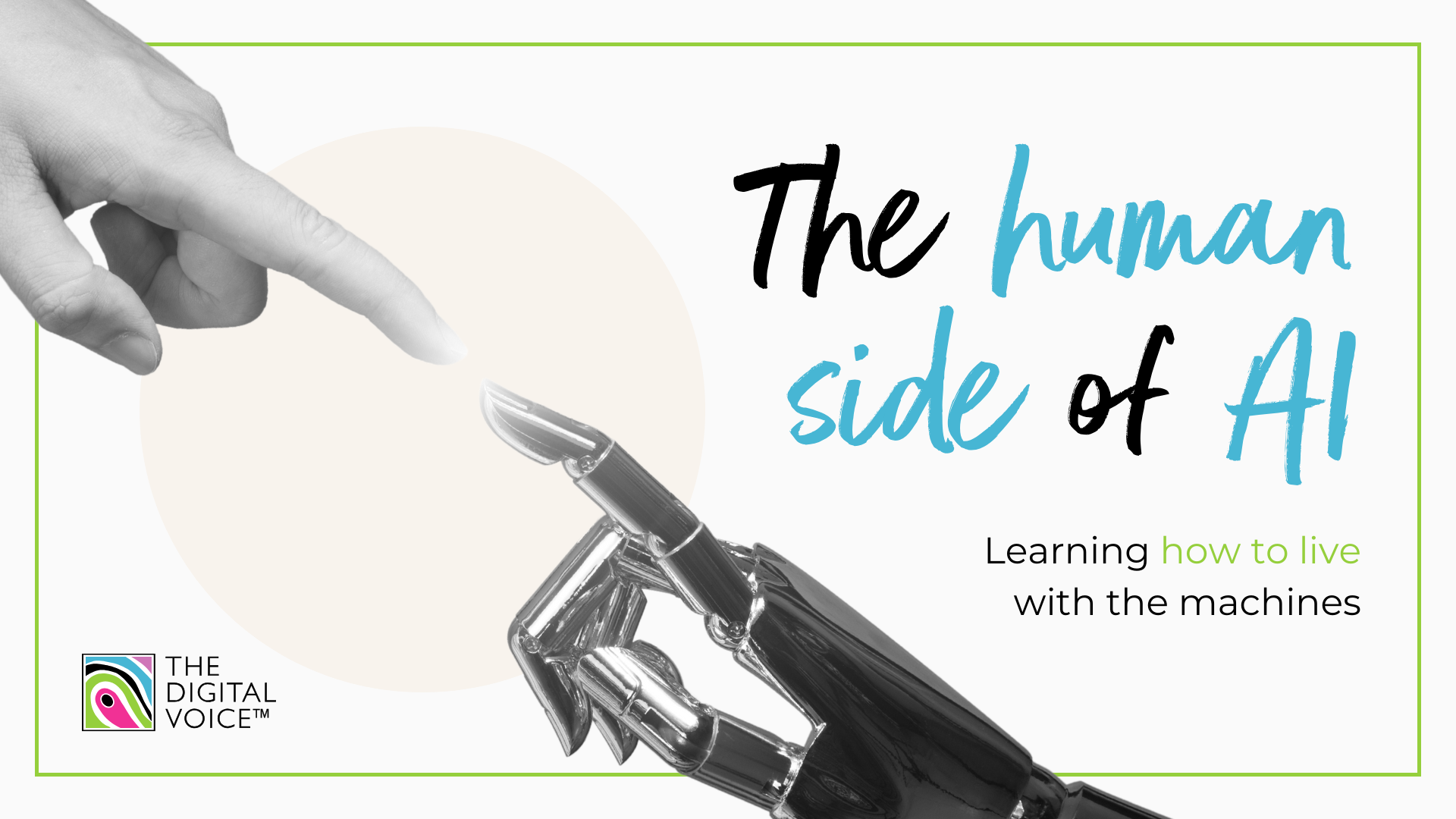
The human side of AI
Learning how to live with the machines
The advent of AI has left many of us pondering some big questions: what are the limits to the technology? Will it augment or replace human intelligence? Could it achieve consciousness or sentience?
Unfortunately, finding clear answers to these questions is less than straightforward - and frequently sobering. When CEOs of major companies were asked about AI’s impact on the human race, around a third (34%) said they believed it had the potential to destroy humanity within ten years. A further 8% warned it could happen within just five.
On the flipside, however, a more hopeful majority (58%) said this scenario could never happen and they were “not worried” about AI as an existential threat to civilization at all.
The stark contrast between these positions underlines the complexity of our current relationship with AI. On the one hand, there is excitement around its potential to retrieve otherwise inaccessible patterns and insights from vast amounts of data. On the other hand, our (perhaps justified) fear of the unknown is triggering some deep misgivings about where it might take us.
In this article, we look beyond the technology itself to consider some of the current points of connection - and disconnection - between AI and humans, and how they might play out in the future.
AI is not without its flaws
Mainstream generative AI is still in its infancy - ChatGPT, for instance, celebrates its first birthday on November 1, 2023 - but in that short space of time questions have arisen over the nature of its output.
A quick search will show plenty of examples of Bard, Bing or other text-generating engines getting it wrong. Rather than delivering factually accurate prose or objectively authentic imagery, AI creations can be
infused with bias and unsavoury opinion, having been polluted by the very data they have ingested. In some cases, AI has been outed as a
bare-faced liar, using data to inform a best guess rather than relying on solid facts or admitting ignorance. Microsoft’s Bing AI chatbot has even been accused of
emotional manipulation.
A less harmful (yet still unhelpful) flaw relates to the basic quality of its language. AI-generated copy can be inherently vanilla, lacking heart and authenticity. Having attempted to find a neutral and inoffensive middle lane, it can, ironically, end up standing out like a sore thumb. Even if you can’t put your finger on what’s wrong, you can tell it’s not quite right - like something straight out of the
uncanny valley.
AI is also attracting criticism where it does things
too well. A case in point is the AI-based face-replacing capabilities of Google Pixel 8’s photo editor, which, while admired by some, are
described by others as ‘icky’ and ‘creepy’. Similarly, where AI tracks patterns in our online search behaviour, for instance finishing our sentences, this can trigger the unnerving feeling that it knows us better than we know ourselves.
Putting data-processing power to good use
Despite these concerns, AI’s superhuman data-processing capabilities undoubtedly deliver a key benefit: whether in the context of generating content or crunching data, AI allows us to work smarter, achieving more in less time.
As a result, the conversation shifts from casting AI as a competitor to contemplating it as a tool for humans to augment creativity. It enables us to unlock insights and improve experiences - whether that’s accelerating drug discoveries or enhancing interactions with brands.
Take personalisation, for example. While highly effective, it is technically challenging to achieve, demanding complex automation of micro tasks at macro scale. For example, by layering AI’s data-processing capabilities with email’s power as a personal identifier, the door is open to highly engaging, highly tailored digital journeys - communications that feel altogether more ‘human’.
This is certainly how
Suzanna Chaplin, CEO of esbconnect, sees AI’s potential for enhancing our digital engagement with brands:
“I’m excited that, as a brand, AI allows you to input all of this data to create a genuine one-to-one experience,” she says. “Meanwhile, as a consumer, I'm thinking: 'You've given me a selection of products that I actually want, rather than showing me everything you have'. That's where I think AI is going to transform the digital world.”
Ultimately, only time will tell what that future looks like and how the bigger questions around AI will unfold before us. However, as any number of examples demonstrate, it’s not a case of ‘them vs us’ when it comes to humans and AI; in fact, it’s often about the intersection and combination of the two. Data-intense AI applications are, after all, designed and engineered by humans. Large language models are trained on human-authored data sets.
So, whether your overriding emotion about AI is one of fear or excitement, the potential impact of AI on our jobs, our lives and our world means we have a responsibility to appreciate and understand its influence, and channel it for the human good.
To hear more from Suzanna, check out
Off Record, On Point - The Human Side of AI.
Meanwhile, to learn more about unlocking the power of data-driven email marketing, visit esbconnect.com.

Having combined her love of language and linguistics with a career in tech marketing and PR, Hazel has gained a wealth of expertise both agency-side and client-side. She loves nothing more than exploring disruptive technology and meeting new faces at industry events (as a German speaker, DMEXCO is a firm favourite).
More from our team & client partners