

Without these insights, your data is just data
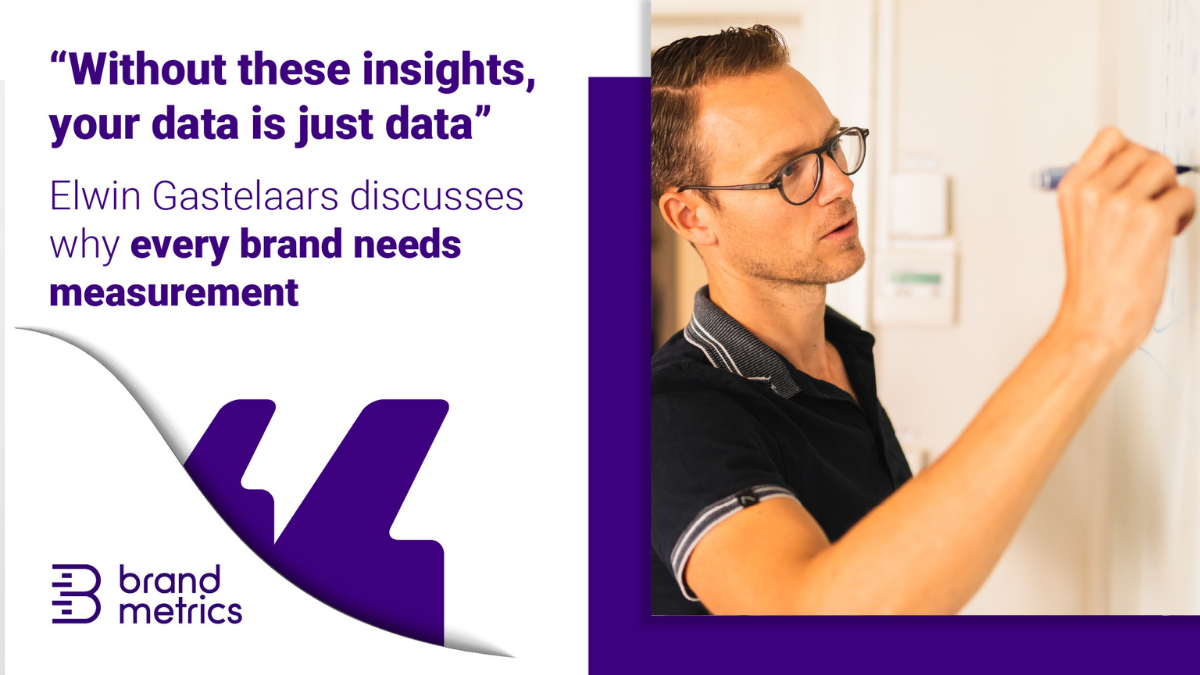
Elwin Gastelaars of Brand Metrics on why every brand needs measurement
In today’s environment, where the focus is often on performance, why is it important that businesses don’t forget about branding?
If no one’s heard of your brand, you’ll get very few sales, if any. Even for established brands, if you’re seeking new audiences to encourage them to buy from you, that means investing in top-of-the-funnel activities. And if you’re investing in brand building, measuring its impact is critical to understand people’s mindsets when they see your advertising.
Brand preference comes down to the association someone has with a brand, which is driven by emotion. All campaigns should aim to create an emotional response, and understanding how your message is resonating is critical. It’s only by asking consumers directly that you can get inside their thinking and determine if your advertising has improved their perception and willingness to consider your product.
Traditionally, brand measurement has centred on time-consuming, costly research undertaken post-campaign. But it’s only through consistent measurement that critical insights into how each campaign’s message contributes to your brand’s perception can be gleaned and action taken. That’s why brand measurement must be embedded in every campaign. And when you approach it like that, brand lift becomes a metric, not simply a piece of research.
As we measure every client campaign in every market, we can also help businesses benchmark how their campaigns compare to others in their industry and markets. All these essential insights are what marketers are searching for today.
So why is brand lift becoming an essential metric?
To hit revenue goals, businesses need to get their messaging right. But if you’re not measuring that, and you lack those insights, you’re blind to how effective and impactful your advertising is.
We are finding that brands are increasingly looking to incorporate upper-funnel metrics to support and drive their performance, and newer media channels, like Connected TV and podcasts, are very interested in measuring brand effects. And it’s not surprising – CTV is a branding environment, and upper-funnel budgets are being spent there. And the nature of video, which allows emotional messages to be shared, aligns well with brand metrics.
Is brand lift purely a long-term metric, or can it be used in the short term?
It’s 100% long-term, but as I’ve said, it must be consistently measured. You’d never consider collecting and monitoring your performance metrics periodically; the same goes for brand measurement. And if you’re not constantly using the power of branding and awareness to unearth new audiences, you need to change your strategy – otherwise your business will die.
What is the relationship between brand lift and attention? Do the two go hand in hand?
Our research has suggested that they do, and we’re looking further into that. We’re working with WeTransfer, an ecosystem of creative productivity tools, that provides a full-screen creative media space for brands and uses strong, impactful visuals to deliver attention-grabbing campaigns. Combining a pleasant user experience with a format that is designed to keep creatives in their workflow, independent research has shown that WeTransfer can sustain people’s attention for significantly longer than other digital ad formats. While intuitively it makes sense that higher attention can be tied to higher brand lift, we want to prove it with data.
One new area where we’re seeing interesting insights emerging is podcasting. Because it’s an intimate experience, attention is high. And being a curated environment, incorporating a few selected brand messages from businesses that match the audience, we’re seeing strong brand uplift.
This positive contribution towards consideration and preference behaviours is repeated across multiple industries. Even for niche audiences, such as business news radio, we’re still seeing podcasts deliver brand lift.
We’re also looking at the cumulative effect of brand lift on impacting behaviours. Moving someone from the consideration to the preference phase takes time, so we’re seeking to identify the frequency of messaging necessary to drive this change.
Can brand lift data play a role in the performance marketing conversation?
It can and it must, because to understand performance data, you need to know why people are buying from you. Have they just discovered your brand? Have they considered you for some time but are only now buying? Or are you their preferred choice and they’ll always purchase from you? Without these insights, your performance data is just data. Brand measurement gives a more rounded view of why people are making decisions.
What new opportunities are branding insights opening up?
Well, it’s all about TV. We’re carrying out our first CTV test with a music broadcaster. By serving ads between music videos, we’ll be measuring how these resonate with the viewer. And because TV creates an emotional connection, it’ll be fascinating to measure brand lift in this environment.
What’s new is that this data will be available in real time. This is a huge change from the usual panel-based research approaches and the associated data access delays. It means the data can be used immediately to optimise campaigns.
That has implications for informing dynamic creatives: if you can gain brand lift data in real-time at scale, this can then be fed into the creative and messaging decisioning. We’re not there, but there’s a real opportunity to take full advantage of this and enhance advertising’s effectiveness and relevancy through the power of brand measurement.
Also published in:
New Digital Age
More from our team & client partners