
From passive viewing to playful engagement: how this Dominos ad break delivers
The Media Leader talks with Lauren Barnett, head of UK sales at Samsung Ads, and Harry Packshaw, head of AV at Havas, about their recent Domino’s ad campaign, the first in Europe to use Samsung Ads’ GameBreaks ad format.
The Media Leader: So, Lauren, could you please explain what GameBreaks is?
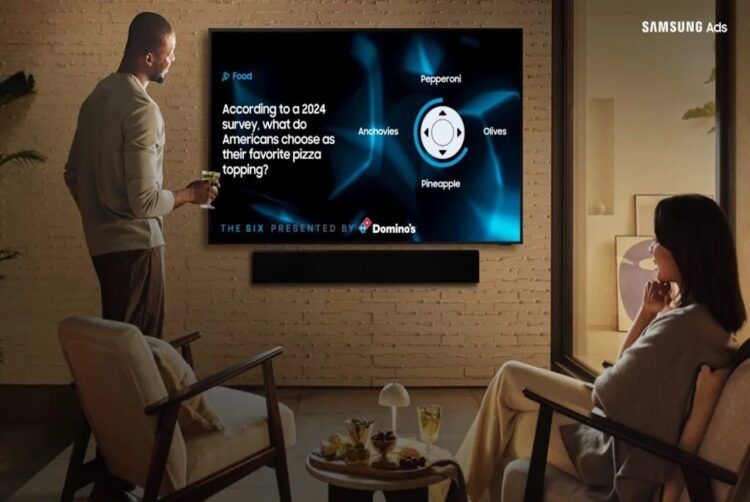
Lauren Barnett: GameBreaks is a new ad unit we introduced earlier this year on the Samsung TV Plus service in the US, Canada, and the UK. Built natively for Samsung Smart TVs, GameBreaks ads take the form of short, remote control-powered trivia quizzes or games that run in the first ad slot of premium commercial ad pods. This offers viewers a frictionless way to engage, while giving advertisers a new medium through which to earn attention. Advertisers can customise trivia questions, themes, and design elements within GameBreaks ads to align with campaign goals.
TML: Why did you introduce the format?
LB: TV is an increasingly interactive medium, so ads should no longer need to follow the old rules of a linear storyline. They, too, can become part of the new era of interactivity. We know that humans are hard-wired to enjoy playing games. In fact, according to Exploding Topics, there are 3.32bn active videogame players worldwide – that’s over 40% of the world’s total population. We know, too, that in the UK, gaming now accounts for 11% of the daily time viewers spend on Samsung smart TVs [source: Samsung, H2 2024], so we thought it was a logical move to bring gaming into advertising.
TML: And Harry, your client, Domino’s, was the first brand to use the format outside of the US. What was the appeal for you?
Harry Packshaw: One of the brand perception mechanics that really works for Domino’s is that it is a crowd-pleaser, and this has a real impact on driving consideration, which is the biggest lever for purchase intent. So, in terms of both building brand awareness and pushing further down the funnel, it really works for them. So we really want to play in that space, be at the heart of those crowd-pleasing moments and grow that association with Domino’s as a much-loved universal brand.
The other point about Domino’s is that, especially in the digital space, it’s always keen to try new ‘firsts’. There’s also been a lot of talk, backed by data, on how gamification really helps shift the dial on key brand metrics. It really encourages loyalty while also increasing the sense of fun that brands are trying to create across all their campaigns.
Finally, CTV sits at the heart of people’s homes, and people really engage with it. So when you put all that together, you can see that GameBreaks was a no-brainer for Domino’s. When the opportunity came up to be the first brand to try this outside the US, it jumped at it because it aligns so well with its brand ethos.
TML: Tell us about the ad.
HP: It was a really authentic activation, where viewers were presented with pizza-related questions such as: “What is the most popular topping for a pizza in the US?” (The answer is anchovy, in case you were wondering.) So people were encouraged to get involved with the ad through the questions, and it proved really popular and engaging.
TML: How did it perform?
HP: Really well. We saw a strong engagement rate of 3.84%. Still, the real vindication for the campaign was a 31% uplift in consideration, mirroring exactly what we thought we would see in terms of driving the perception of Domino’s as a crowd-pleaser, which led to this big increase in consideration.
TML: Lauren, you must be delighted to hear numbers like these.
LB: Yes, they very much tally with independent research on GameBreaks ads carried out by MediaScience in the US, which found they deliver a 53% lift in unaided brand recall, outperforming standard video ads by 1.5x. The study also found that 89% of viewers preferred GameBreaks over traditional commercial breaks. So it was great to see this reflected in the UK.
ML: So are there more GameBreaks campaigns in the pipeline, Harry?
HP: For sure, and moving forward and learning from this campaign, we can be a bit braver, a bit cheekier, a bit more provocative with some of the questions next time.
TML: And Lauren, from your perspective, you must be pleased that GameBreaks is go in the UK.
LB: Yes, for sure, we have seen a lot of success for brands in the US with Gamebreaks, so I am excited to bring it to our partners in the UK, finally. Our test with Havas and Domino’s has been a huge success, and people can look forward to seeing and engaging with many more GameBreaks ads going forward.
Also Published in: The Media Leader
More from our team & client partners